
























Advertisement
Agreeee
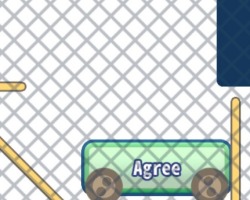
Agreeee is a short-form action game that redefines how players interact with familiar interface elements. Instead of starting with movement or combat, the game begins by confronting the player with agreement screens that must be accepted to proceed. These screens are not decorative or passive. They represent the first challenge and establish the core idea that interaction itself is the primary test. The player advances by understanding behavior, not by following expectation.
Agreement Screens as Active Systems
From the first moments, Agreeee positions interface elements as dynamic systems. Buttons, panels, and prompts look familiar but respond in ways that contradict standard logic. Some inputs behave inconsistently, while others appear functional but serve no purpose. The game offers no explanation of these rules, forcing the player to observe patterns and adjust behavior. This phase functions as both introduction and filter, requiring attention rather than speed.
Learning Through Interface Behavior
The early portion of Agreeee trains the player to treat every element as potentially misleading. Visual simplicity remains constant, but interaction rules shift between screens. The player learns not by instruction but by consequence, gradually forming an understanding of how valid inputs differ from decoys. This learning process becomes the foundation for later challenges, where assumptions are punished more than hesitation.
Core Interaction Loop
Once the agreement phase is completed, Agreeee moves into a faster sequence of interaction-based challenges. The same principles remain, but timing becomes more demanding. In the middle of the experience, the player repeatedly performs a set of actions that define the main loop:
- Scanning the interface to locate functional input zones
- Responding to prompts that change position or behavior
- Adjusting timing when input windows shift unexpectedly
- Ignoring visual distractions that mimic valid controls
- Recalling interface patterns encountered earlier
These actions combine perception and reaction rather than strategy or planning.
Difficulty and Progression Structure
Agreeee does not include levels, scores, or persistent upgrades. Progress is represented by completion of increasingly demanding interaction sequences. Difficulty increases by reducing margin for error and introducing more misleading elements, not by adding new mechanics. The player’s improvement comes from recognition and adaptation, as earlier lessons are reused in tighter conditions.
Advertisement


















































Comments