


























Advertisement
Beltmatic
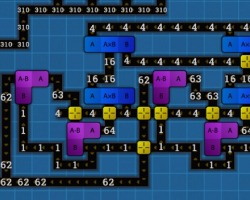
Beltmatic is a factory automation and puzzle strategy game focused on resource transportation and number-based production chains. The player builds conveyor belt systems that move and combine units to generate higher-value outputs. The game centers on optimization, requiring careful placement of machines and transport lines to maintain efficiency. Progression depends on solving increasingly complex production challenges rather than completing narrative objectives.
Core Concept And Objective
In Beltmatic, the main goal is to create mathematical production loops that generate specific target values. Players begin with simple numerical resources and must use operators and processing units to transform them into required outputs. Each completed objective unlocks new components that expand available strategies. The structure encourages experimentation, as multiple layouts can achieve the same result with different levels of efficiency.
The environment is presented on a grid-based map where conveyor belts connect generators, splitters, mergers, and calculation modules. Space management becomes important as production chains grow in size and complexity. Limited area forces players to rethink layouts and redesign systems when inefficiencies appear.
Mechanics And Systems
Beltmatic relies on interconnected systems that simulate automated production. The main gameplay elements include:
- Conveyor belts that transport numerical units
- Machines that perform addition, subtraction, multiplication, or division
- Splitters and mergers for routing flows
- Storage units for buffering excess output
- Upgrade systems that increase throughput speed
Each system interacts continuously, so even small placement changes can affect the entire network. Timing and throughput balance are central to maintaining steady output.
Progression And Scaling
As objectives become more advanced, target values require multi-step production chains. Players must design layered systems where intermediate results feed into secondary calculations. Optimization often involves minimizing belt length while maximizing output speed. Scaling production may require duplication of efficient modules and reconfiguration of older layouts.
Beltmatic emphasizes logical thinking and spatial planning. There is no direct combat or time pressure, but inefficiency slows progression. Success depends on analyzing bottlenecks, balancing input rates, and refining layout structure. Over time, production networks grow into complex automated systems that reflect the player’s strategic approach to problem solving.
Advertisement




























































Comments