



















Advertisement
Muse Dash
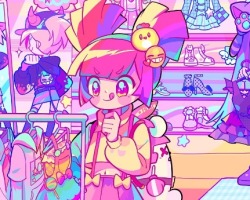
Muse Dash combines a rhythm game with the presentation of a side-scrolling action runner. The player selects one of the Muses and travels through animated stages while enemies, notes, hearts, and obstacles approach from the right. A short background premise concerns restoring a world whose musical score has been disrupted, but the game does not develop this idea as a continuous campaign. Its main focus is completing songs and improving scores.
Two Lanes Contain the Entire Note Chart
Every stage is divided into an upper and lower lane. Ground enemies are attacked with one input, while another input makes the character jump and strike targets in the air. Some notes must be held, and larger enemies may require several rapid hits. Obstacles such as saws should be avoided instead of attacked. Since the Muse runs automatically, the player only needs to concentrate on timing and lane selection.
Characters Modify Scoring and Survival
Rin, Buro, Marija, and additional playable characters appear in different costumes with individual abilities. One character may improve score calculation, protect a combo, recover health, or change how mistakes are judged. Elfins accompany the selected Muse and provide another passive effect. Choosing a suitable character and Elfin combination can make difficult songs easier or increase the score during an accurate performance.
Important gameplay elements include:
- Attacking enemies in the upper and lower lanes
- Holding long notes until their marked endpoint
- Avoiding hazards that cannot be defeated
- Collecting hearts to restore lost health
- Maintaining a combo through accurate timing
- Filling the Fever Gauge with successful actions
- Defeating bosses during selected parts of a song
- Choosing characters and Elfins with useful abilities
Songs Function as Individual Levels
Muse Dash organizes progression around songs rather than story chapters. Most tracks offer several charts with different difficulty ratings, including Easy, Hard, and Master. Hidden charts are also available for certain songs. Completing a track provides experience, and level increases can unlock music, illustrations, characters, Elfins, and other content. Each result screen records accuracy, combo length, score, and performance grade.
To improve, begin with a difficulty where individual targets are easy to read and listen for the beat instead of relying only on their positions. Adjusting the timing offset can correct a delay between the music and inputs. Use separate fingers or keys for the two lanes so fast alternating patterns do not depend on one hand. A missed enemy breaks the combo, while collisions reduce health and may end the stage. Replaying the same chart helps memorize difficult sections, improve timing judgments, and work toward a full combo or an all-perfect result.
Advertisement
































Comments