


























Advertisement
The Dark Queen Of Mortholme
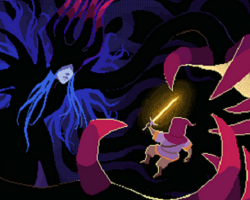
The Dark Queen Of Mortholme is a short narrative-driven game that places the player in the role of a final boss rather than a hero. The entire experience takes place in a single throne room, where the Queen repeatedly confronts a hero who continues to return after defeat. The structure is based on a cycle of encounters, where each battle slightly changes the dynamic between the two characters. The gameplay is minimal, but the focus is on how repetition affects both the character and the player.
Role Reversal And Core Concept
The main concept of The Dark Queen Of Mortholme is reversing the typical perspective of a boss fight. Instead of progressing as a hero, the player remains in a fixed position while the opponent evolves over time. The Queen has a limited set of abilities and cannot significantly change her strategy. Meanwhile, the hero becomes stronger, learns attack patterns, and adapts with each attempt. This creates a system where the player experiences gradual loss of control.
Combat Loop And Interaction
Gameplay is structured around repeated combat encounters followed by short dialogue exchanges. Each fight begins similarly, but the outcome shifts as the hero improves. The player uses a small set of attacks to defeat the opponent, but over time these actions become less effective. The loop emphasizes consistency rather than skill growth.
- Repeated boss fights within a single location
- Limited set of abilities for the player
- Opponent that improves after each defeat
- Dialogue sequences between encounters
- Multiple endings based on interaction choices
Narrative Development And Themes
The narrative evolves through conversations that occur between battles. Dialogue changes as the situation progresses, reflecting shifts in the Queen’s perception and confidence. The interaction between the two characters becomes central to the experience, with each exchange adding context to the conflict.
The game explores themes related to repetition, change, and the nature of progression. While the hero represents adaptation and improvement, the Queen remains fixed in behavior. This contrast drives the story forward and shapes how the player interprets each encounter.
The Dark Queen Of Mortholme maintains engagement through its structured loop and narrative focus. The gameplay remains simple, but the evolving relationship between characters provides variation. Each session reflects how the player responds to repeated encounters and changing conditions, making progression dependent on observation and interpretation rather than mechanical complexity.
Advertisement


























































Comments