


























Advertisement
Wheelie Life Scratch
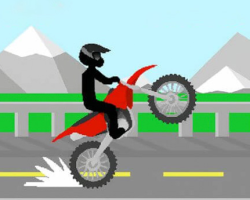
Wheelie Life Scratch is a browser-based motorcycle game created with the Scratch engine, focusing on balance control and distance-based challenges. The player controls a rider on a motorcycle and attempts to keep the front wheel lifted for as long as possible without crashing. Gameplay is simple in concept but requires steady input and timing. Each attempt begins instantly, making the game suitable for short sessions and repeated practice.
Balance Mechanics And Core Objective
The main objective in Wheelie Life Scratch is to maintain a wheelie while moving forward across a flat or slightly changing surface. The player adjusts acceleration and balance using basic controls, and small input changes can have a noticeable effect on stability. If the motorcycle tips too far backward or the front wheel touches the ground, the attempt ends. There are no checkpoints or secondary goals, so success is measured by distance or time achieved during a single run.
Controls And Player Input
Controls in Wheelie Life Scratch are intentionally limited to keep focus on balance management. Acceleration increases lift, while releasing input helps stabilize the bike. Because the Scratch engine emphasizes straightforward interaction, there are no advanced physics systems or customization options. Players learn through repetition how much input is required to maintain balance. Overcorrection is a common reason for failure, reinforcing careful control rather than aggressive input.
Core Gameplay Elements
Wheelie Life Scratch is structured around a small set of consistent gameplay elements:
- A single motorcycle with fixed handling
- Balance-based wheelie mechanics
- Distance or time tracking per attempt
- Immediate restarts after failure
- Simple visual feedback for position and tilt
These elements remain the same across all attempts. Since there are no upgrades or unlockable content, improvement depends entirely on player skill. Mastery comes from understanding how the bike responds to sustained input over time.
Learning Curve And Skill Development
The learning curve in Wheelie Life Scratch is gradual. Early attempts often end quickly, but players begin to recognize balance thresholds with practice. Maintaining a steady wheelie for longer distances requires patience and consistency rather than fast reactions. Because feedback is immediate, players can quickly identify mistakes and adjust their approach on the next attempt.
Advertisement





















































Comments