


























Advertisement
Doom on Browser
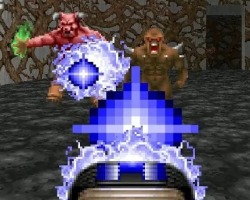
The first few minutes of Doom on Browser teach a simple rule: entering a room is easy, but getting back out can require much more planning. The game places the player in control of a marine trapped inside facilities overrun by demons after teleportation experiments go wrong. The campaign is not built around dialogue or character relationships. Instead, the story advances through new maps, stronger enemies, and increasingly hostile environments as the player fights deeper into the invasion.
Search for Keys, Switches, and Supplies
Each map is designed as a compact maze filled with locked doors, elevators, branching corridors, and hidden spaces. Some areas cannot be reached until a red, blue, or yellow keycard is found, while switches can raise platforms, unlock passages, or reveal routes that were previously inaccessible. The player often returns to earlier rooms after opening a new path, so remembering the layout makes exploration faster.
A typical level may contain:
- colored keycards for secured doors;
- switches that alter parts of the map;
- secret rooms with additional supplies;
- armor and health pickups;
- ammunition for different weapon types;
- elevators and platforms connecting separate areas;
- an exit switch that finishes the map.
The automap records explored sections and helps identify unexplored corridors, but many secrets still require attention to wall textures and unusual room shapes.
Control Space During Combat
Doom on Browser is not about standing still and trading damage. Enemies are easier to manage when the player keeps moving, dodges projectiles, and uses the shape of the room to control how many demons can attack at once.
The weapon system supports several approaches. The shotgun delivers strong close-range damage, while the chaingun provides sustained fire against groups. The rocket launcher can clear stronger enemies quickly but becomes dangerous in narrow rooms because its explosions damage the player as well. Plasma weapons offer high damage later in the campaign, and the BFG 9000 is best saved for encounters where several dangerous targets appear at once.
Enemy behavior also changes how a room should be approached. Pinkies try to close the distance, Imps attack with fireballs, Cacodemons float through open areas, and stronger demons can absorb large amounts of ammunition. Monsters can also damage one another, sometimes causing fights between different enemy types.
Finish the Map Without Wasting Resources
The campaign uses fixed levels rather than randomized runs. Each completed map leads to another location, often with more complex layouts and larger enemy groups.
Health and ammunition management become increasingly important because a poor decision early in a level can make the final rooms much harder. Using the strongest weapon on every weak enemy may feel efficient at first, but it can leave the player with limited options when a tougher encounter appears.
Advertisement
























































Comments