

























Advertisement
Track and Field
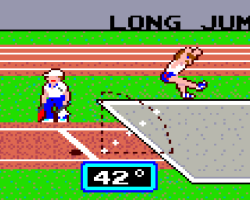
Track and Field is a sports game built around short athletic events where every result depends on how well the player handles speed, rhythm, and timing. There is no story, dialogue, or character-based campaign. Instead, the game moves through a fixed set of competitions, and each one asks for a different type of input. The goal is to meet the qualifying standard, continue to the next event, and improve personal records across repeated attempts.
Adapt to a Different Event Each Time
The game includes six main disciplines, and they do not all play the same way. Running events reward fast repeated input, while jumps and throws add an extra moment where the player must release or press the action at the correct time.
The event list includes:
- 100 Meter Dash;
- Long Jump;
- Javelin Throw;
- 110 Meter Hurdles;
- Hammer Throw;
- High Jump.
The 100 Meter Dash is based almost entirely on speed. The faster the player alternates the running controls, the faster the athlete moves. Long Jump adds a takeoff line, so the player must build speed first and then jump without crossing the mark too late.
Combine Speed With Precision
Javelin Throw also begins with a running approach, but the main challenge is choosing the release angle. A fast approach improves the potential distance, but the throw still depends on timing the release correctly.
The 110 Meter Hurdles requires a more consistent rhythm. Players must maintain running speed while pressing the jump control at the right moment for every hurdle. Missing the timing on one obstacle can slow the athlete and affect the rest of the race.
Hammer Throw is different again because there is no normal sprint. The player builds rotation and then releases the hammer at the right point. High Jump uses an approach run followed by a carefully timed takeoff, making it another event where speed alone is not enough.
Qualify Before Moving On
Track and Field does not have traditional levels with exploration or enemies. Each athletic event acts as a separate stage, and the player must reach the required time, distance, or height to continue.
Later rounds can demand better performances, so consistency matters across all six disciplines. A fast 100 Meter Dash does not help if the player cannot control the Long Jump or misses several hurdles.
The main challenge comes from switching between different timing systems while using only a small set of controls. Some events reward rapid button presses, others depend on release timing, and a few combine both. Improvement comes from learning the rhythm of every discipline, recognizing when maximum speed is useful, and knowing when a more controlled input produces a better result.
Advertisement























































Comments