

























Advertisement
Trolley Problem
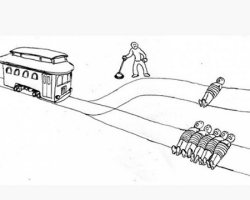
Two buttons control every outcome in Trolley Problem: one changes the track, and the other leaves the trolley on its current route. Before choosing, the player reads who or what will be affected by each action. The first problem follows the standard philosophical example of sacrificing one person to save five, but the following questions alter the numbers, values, and personal connections involved.
When Arithmetic Stops Being Enough
Some early decisions can be approached by counting potential deaths. Later stages make this method less useful by introducing money, possessions, animals, family members, and uncertain information. The player may be asked to compare several people with personal savings, a valuable artwork, or their own life. Other scenarios change how directly the player is responsible for what happens.
A Fixed Route Through 28 Questions
The game is divided into 28 short levels. Each one contains an illustration, a description, and two available responses. Selecting Pull the Lever diverts the trolley, while Do Nothing allows the original event to continue. Once a response has been confirmed, it cannot be changed during that run. The next dilemma then appears with a new set of conditions.
The problems examine choices involving:
- one life against several lives;
- people with different ages or relationships;
- sentient creatures and artificial intelligence;
- economic damage and indirect consequences;
- events in the present, future, or an endless loop.
Comparing Decisions with Other Players
There are no movement controls, puzzles, inventories, or action sequences. Gameplay consists of reading each situation and clicking the preferred response. After the decision, statistics show how other participants answered the same question. Choosing the minority option does not cause failure, and there is no score for following a particular ethical system. The percentages are included for comparison rather than evaluation.
Trolley Problem keeps track of casualties across the full set of scenarios. The final level changes the subject from consequences to free will and asks whether the player’s decisions were genuinely chosen or predetermined. After it is completed, the game presents a conclusion and displays the total kill count. Players can restart to select the opposite responses, compare another result, or examine whether their choices remain consistent when the wording and stakes change.
Advertisement



















































Comments